The Region
Antalya & Lycia.
A short guide to the stretch of Turkey’s Mediterranean coast this whole site keeps circling back to — the modern city of Antalya, and Lycia, the ancient region just southwest of it.
No product talk here. Just the place.
The coast
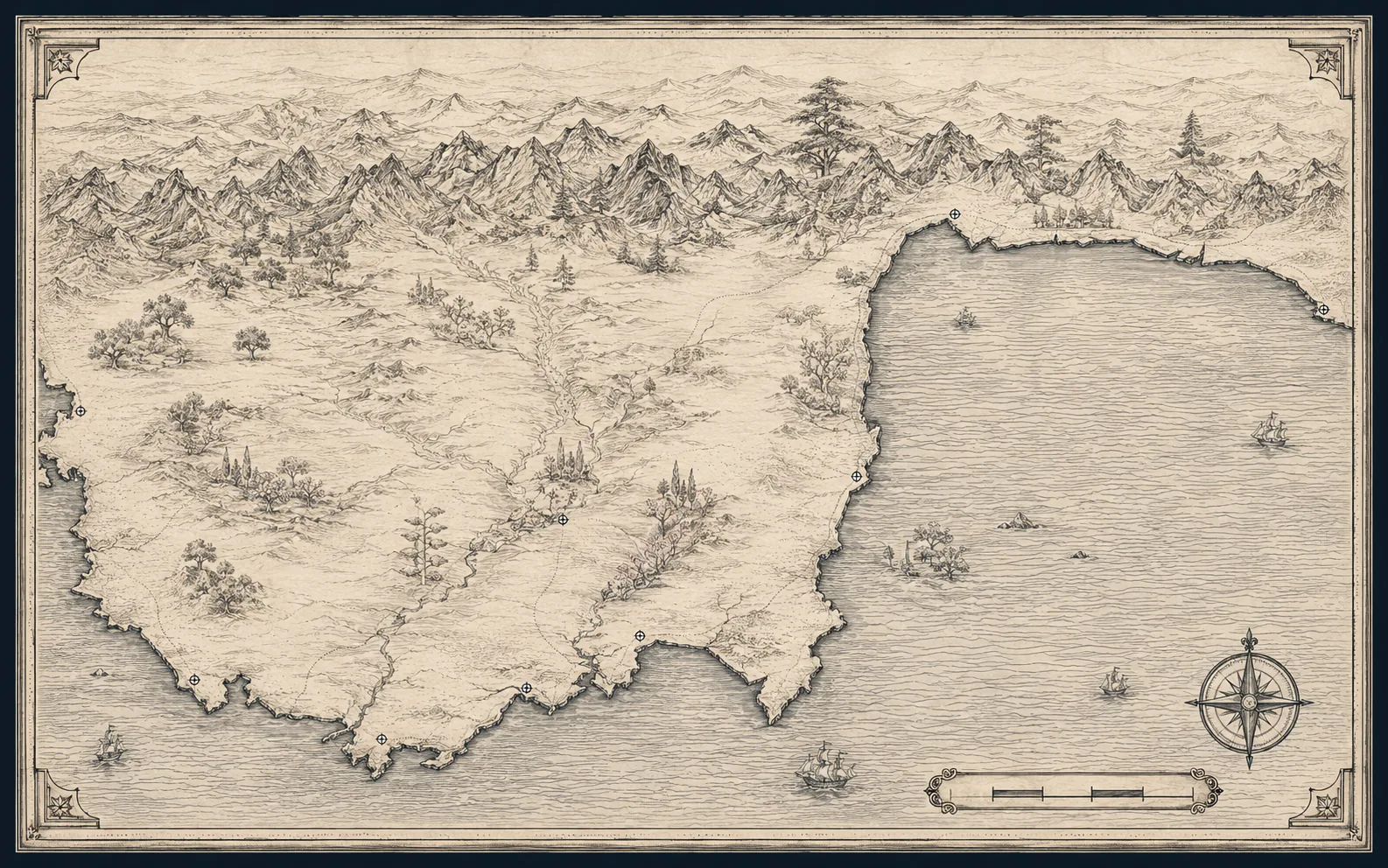
Antalya sits on the wide gulf at the coast’s eastern end; Lycia is the mountainous peninsula curving away to the southwest, toward Kaş and Fethiye.
A short history
- 01
Before Rome
A coast of independent cities.
Lycia was never one kingdom — it was a loose federation of small, fiercely independent city-states along the southwest coast, from Xanthos to Kaunos. Rather than bow to outside rule, Lycian cities are remembered for choosing destruction over surrender: Xanthos burned itself rather than fall to Persian and, centuries later, Roman forces.
- 02
Lycian League
An early federation of equals.
The cities eventually formed the Lycian League — member cities voted with weight based on size, sharing a common treasury and shared officials instead of one ruling city. It's one of history's earlier examples of federated self-government, and it left behind an unusually large number of well-preserved theatres, tombs, and civic buildings.
- 03
Rock tombs & sarcophagi
Cut into the cliffs, not built on the ground.
The clearest Lycian signature is architectural: house-shaped tombs carved directly into cliff faces, and freestanding sarcophagi shaped like upturned boat hulls. Myra (today's Demre) and Xanthos still show whole tomb façades cut straight from the rock.
- 04
Pamphylia & Rome
Antalya's own side of the coast.
Antalya sits just east of Lycia, in what was ancient Pamphylia. Roman-era cities here — Perge, Aspendos, Side — built on a flatter coastal plain, and left behind one of the best-preserved Roman theatres anywhere: Aspendos, still used for performances today.
- 05
Myra & Saint Nicholas
Where Santa Claus was a bishop.
Myra's most famous resident was its 4th-century bishop, Nicholas of Myra — the historical figure behind the Santa Claus legend. His church still stands in Demre, alongside Myra's rock-cut necropolis.
Worth knowing
The Taurus range
The Toros mountains rise straight from the coast, often snow-capped while the shoreline stays warm — the backdrop to almost every view along this coast.
Yanartaş — the eternal flames
Natural gas seeping through rock has kept small flames burning on a hillside near Çıralı for at least 2,500 years — the likely source of the ancient Chimaera myth.
The Lycian Way
A ~540 km waymarked trail tracing the old coast from Fethiye to Antalya, past ruins, pine forest, and small harbor towns — one of the world's first long-distance trails of its kind.
Kaleiçi, Antalya's old town
Antalya's walled old harbor quarter — narrow stone streets, Ottoman-era houses, and a Roman harbor still in use, right beside the modern city.
Aspendos theatre
A 2nd-century Roman theatre so structurally complete it still hosts opera and ballet, acoustics largely unaided by modern equipment.
Oleander & wild olive
Pink oleander lines the seasonal riverbeds; old olive and cedar groves cover the hills — the everyday plant life this whole coast is built around.
A federation of stubborn cities, a coast of rock tombs and pine forest, and a modern city still built around the same harbor.